 Fraunhofer Institute for Manufacturing Engineering and Automation IPA
FlexAmp improves the cable handling abilities of assembly robots, enabling them to automatically adapt to changing conditions or new variants. Instead of rigid programming, we build multimodal robot policies that combine vision, tactile sensing and force control for reliable wire harness assembly – powered by Physical AI. Join in!
FlexAmp - Flexible Autonomous Wire Harness Assembly using Adaptable Multimodal Robot Policies
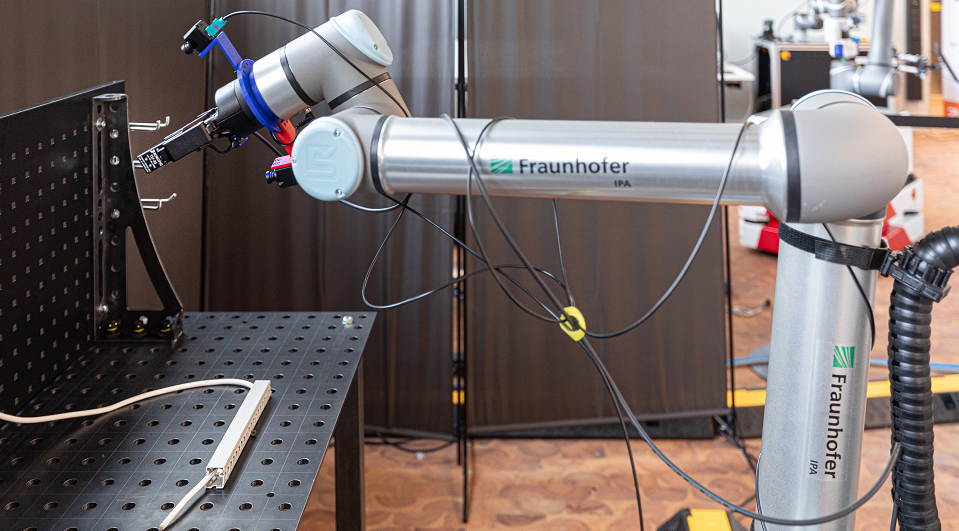
The test environment at Fraunhofer IPA can be adapted for different cable handling tasks allowing to evaluate our approach under realistic conditions – across different materials, variants and environmental conditions.
Wire harness assembly: automated solutions exist, but they can’t adapt
Wire harnesses are found in almost every technical product – from steering wheels and home installations to laboratory equipment. Their manufacturing is divided into cutting, pre-assembly and final assembly. Even though the final assembly accounts for 70 % of the total production time, up to 90 % of the final assembly tasks are currently done manually.
The applicability of robotics for cable and other deformable object handling, specifically the automated wire harness manufacturing, has already been proven by researchers and practitioners. However, most of the existing solutions are tailored to one fixed task in one fixed setup and cannot react when conditions or parts change. Every new variant means renewed programming effort, which makes them uneconomical for real production.
The Goal of FlexAmp: Economic Efficiency through better Flexibility and Reliability
The goal of the FlexAmp project is to provide a solution that comes with enhanced economic efficiency, overcoming industry-specific challenges such as the products’ complexity, production in lot-size-one, and the large variety of different manipulation tasks. Specifically, the project results will allow for:
- Better flexibility during program execution, allowing to cope e.g. with varying environmental conditions (variable setup of the work bench, vague positioning of working materials, lighting etc.) or challenging material properties (different cable thickness, texture or stiffness; black, shiny or reflective cables that are hard to detect by state-of-the-art image processing methods).
- Reduction of failures in the process execution, e.g. where the robot – due to the above-mentioned challenges – cannot pick up a cable or when cables are getting stuck.
- Easy transfer of existing solutions to different tasks and setups, without having to re-implement each individual task, thus allowing a significant reduction of the installation and implementation efforts.
The FlexAmp approach: Robots that feel, see and keep learning
FlexAmp develops adaptable, multimodal robot policies that reliably handle cables and flexible parts even under changing materials, variants and environmental conditions. Instead of rigid end-to-end models, we use a hybrid learning framework that acquires new skills from minimal training data and generalizes them to new situations.
During operation, the robot is instructed using text, images, or video explanations of the cable harness assembly task. After that it autonomously plans the necessary steps and executes them autonomously.
The four core building blocks
Building block |
Your benefit |
Multimodal perception (vision + force + tactile) |
Detects whether a cable is slipping, jamming or seated correctly – robust even with shiny or dark cables and under occlusion |
Predictive failure prevention |
Abnormal tension, incipient slip or jamming are detected before a failure occurs – instead of reacting afterwards |
Modular skills + AI orchestrator (VLM) |
Reusable skills (grasp, route, insert, bend, push) are planned, monitored and adapted by a Vision Language Model |
Learning from few examples |
New situations are taught via teleoperation in a short time – continuous improvement during operation |
What multimodal perception makes possible
- In-hand cable state estimation: tactile sensing detects whether a cable is slipping, stuck or correctly positioned.
- Fine-grained insertion control: force and tactile feedback enable precise mating – even when the camera cannot see the contact point.
- Adaptive grip modulation: grasp force adjusts in real time to avoid cable damage while maintaining a secure hold.
Want to Get Involved? Test your use case with us
Do you manufacture wire harnesses, process flexible tubing, or face an assembly task that is hard to automate? Bring it to our test environment. We actively involve interested companies – system integrators as well as end users – in the development process.
What we offer:
- See the demonstrator live: visit us in our labs at the Innovation Park Artificial Intelligence (IPAI) as part of Fraunhofer HNFIZ in Heilbronn and experience the approach in action.
- Contribute your requirements: your variants, materials, environmental conditions and relevant KPIs feed into the technical implementation.
- Provide sample parts: real cables, connectors and components (or their part numbers) help us reproduce your conditions.
- Phase 2 perspective: joint validation and transfer into your real-world production environment.
Your benefit: a well-founded assessment for your own process, early access to the project results, and direct influence on the development direction – before the technology reaches the market.
FlexAmp is built on proven technology
FlexAmp combines proven building blocks from Fraunhofer IPA into a new overall approach:
- Handling of deformable parts – e.g. coordinated two-arm wiring of control cabinets.
- Force-controlled assembly via our control software pitasc, which abstracts sequence control, force control and error handling into reusable skills.
- Imitation learning & teleoperation – successfully demonstrated on a mobile manipulator for machine-tending tasks (opening doors, pressing buttons, grasping objects).
These foundations are being advanced at the Fraunhofer Heilbronn Research and Innovation Centers HNFIZ, specifically in the Center "AI-powered Robotics".